The We Three Loggerheads is a historic inn in the picturesque Alyn valley, on the road between Mold, the county town of Flintshire, and Ruthin in Denbighshire. The inn sign as I remembered it from childhood featured the faces of three grumpy farmers, each turned away from the others (its modern replacement has lost one of the three, which rather loses the point of the name, I’d have thought).
Since hillwalking became popular in the 1930s, the inn has become not just a popular wayside stopping point, but has capitalised on its natural location as the starting point for cllmbing Moel Famau, and the surrounding area is now simply known as “Loggerheads” which even in the fifties was the destination for buses from as far away as Birkenhead. Catering for large parties of children, it had gardens, a café, slot machines, ice cream and sweet stalls. A little inland resort of its own which, as the final stop on a lengthy bus and ferry journey, was a magnet for children who usually had to be prised away from its attractions by their party leaders.
The usual route up the mountain took us along the main road towards Ruthin for a bit, then we took a right fork up a long, but not particularly steep lane leading uphill. After about a mile you came to a gap in the wall where a footpath went off at right angles, continuing up the hill. Since 1970 it’s been part of the Offa’s Dyke long distance footpath linking the coasts of north and south Wales. Soon you were on open moorland, with dense bracken and carpets of low-growng bilberry plants. At the right time of year, these provided welcome nibbles and an opportunity to rest for a bit.
The path wound around up the hillside, soon giving our first glimpses of the Jubilee Tower, our ultimate destination. The story we were told at the time by Dad was that the mad King knew of Moel Famau, heard that it was 1800 feet high and decreed it should be officially be made a mountain by the building of a two hundred foot tower. Though the story is probably apocryphal, he got his wish in 1810 thanks to local landowners and civic dignitaries. But it wasn’t to last – you can read the full story on its own web page.
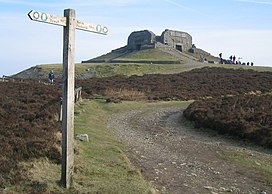
When we finally reached the summit plateau, despite tiredness, small boys always had to climb what was little more than a huge pile of slate rubble to the highest point of the tower, probably fifty feet, and stand waving to those on the ground above one of the huge Egyptian-style porticos. It was probably a health and safety nightmare; the stones were all loose, but I never heard of any accidents there. Nowadays apparently one of the corner towers has been reconstructed and there are steps to get to the top, which is far safer but can’t be nearly as much fun.
The view from the top was spectacular, of course. You could see all the way to the North Wales coast, across the wide Dee estuary to the Wirral, and on a clear day someone could always point out Liverpool Cathedral (there was only one in the 1950s) and even Blackpool Tower.
One of the cub leaders (probably Dad) always had a mental eye on bus timetables and the likely length of time it would take to descend to the nearest stop, so time at the summit was always limited. We usually took a different way down via a route that was straighter but more undulating with a series of plateaus. On the rare occasions we took this route up, it was less interesting: several times you’d spot the tower, think you were nearly there.. and then find yet another climb ahead to the next plateau. One year we discovered the skeleton of a sheep, still covered in wool, which for small boys was the highlight of the day. We weren’t called wolf cubs for nothing!
This north-east descent led eventually to a very pleasant level walk through the wooded valley of the Alyn, known as the “Leete Walk”, with the river a hundred yards or so away down a steep slope. In my mind the river was to the right of the path, but looking at the map today it seems to be on the left.. maybe someone can explain, or has better memories than me? Half way along was a huge cavern called the Devil’s Cave, where we loved to stop on a footbridge, throw stones and shout to hear the echo, until we were told to “hurry up or we’ll miss the bus”. The Leete Walk led eventually to civilisation in the form of the little village of Pantymwyn and its very lonely bus stop. On rare occasions we might have to keep walking back to Loggerheads, but usually a local bus to Mold could be relied on to turn up eventually. Thus began the long return to Liverpool. I can remember very little (no, make that nothing) of the return journeys by bus and ferry for obvious reasons – we probably spent most of them asleep!
This lovely animation shows the construction (and destruction) of Jubilee Tower on the summit of Moel Famau. The penultimate shot shows the ruins of the tower as I remember them in the fifties and sixties.

 Dave's Memories
Leave a reply to The Journey – Dave's Memories Cancel reply