3. Holiday Fun
The single track lane continued past the farm to the coast, which was about a mile. There were a few other houses along the way but the only ones I remember were a pair of semi-detatched stone cottages with a corrugated iron roof and walls painted a distinctive bright pink (they’re still there, still pink). We called Porth Colmon the “rocky beach” because it was the place to go at low tide for rock pools, fish, crabs and sea anemones. With the aid of nets we transferred many a poor marine creature into a bucket, showed it to parents and of course released it back into a pool before we left. Occasionally Dad would smash a limpet and we’d feed bits of it to the sea anemones, marvelling at how they used their tentacles to gobble the meat, never to be seen again.
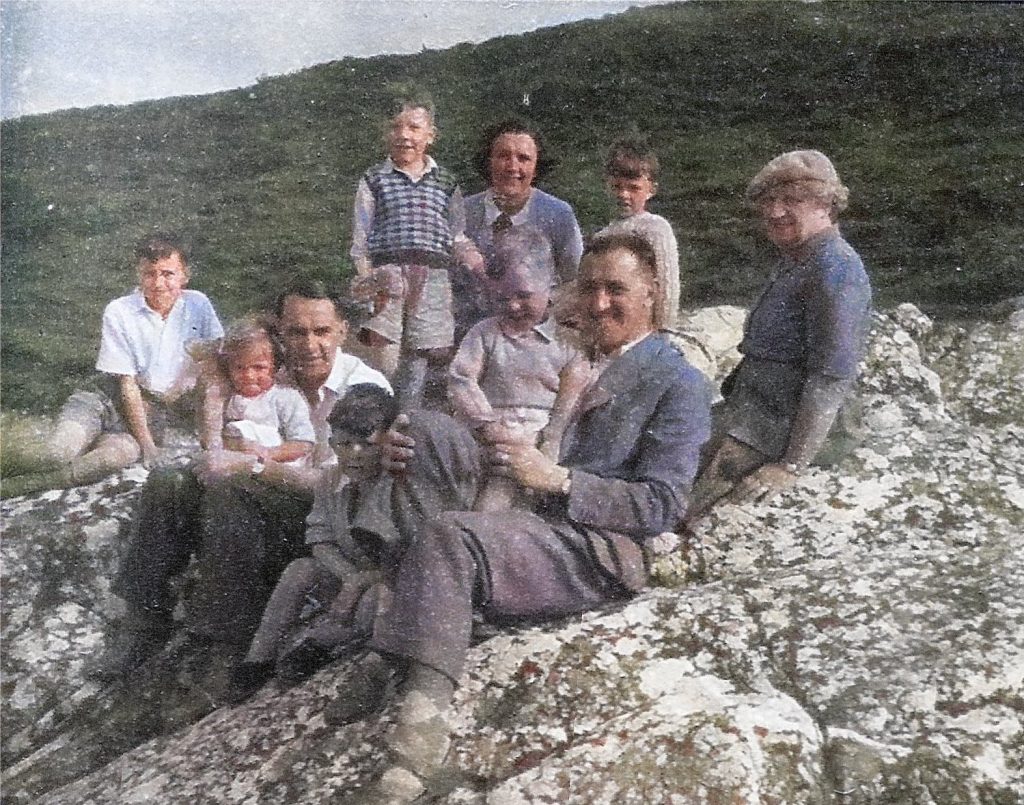
Back L-R: Alan, me, Mum, Grahame, Nana
Front L-R: Pam, Uncle Geoff, Peter, Ian, Uncle Emlyn
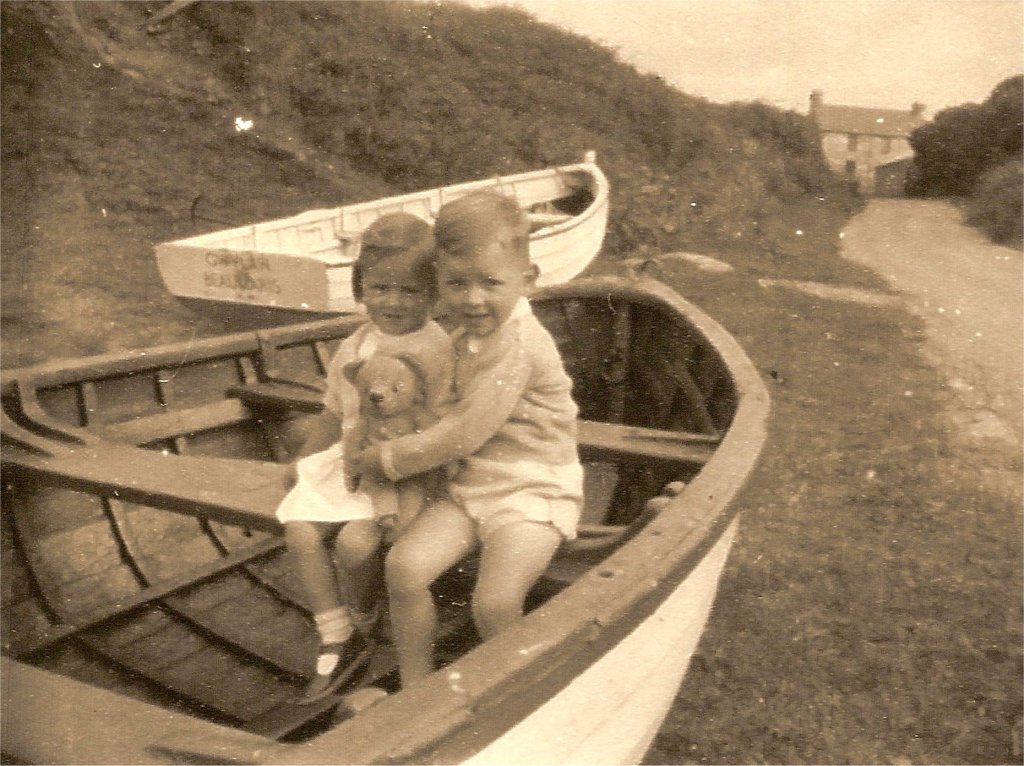
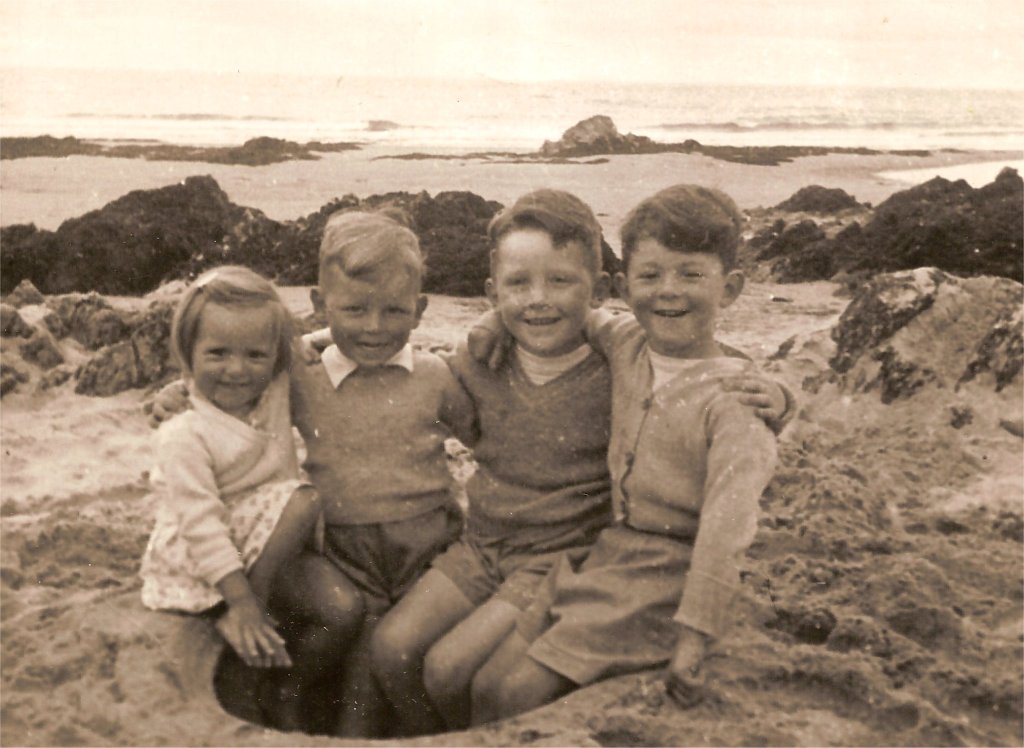
If it was sand castles we wanted, then we took spades as well as the buckets and turned right at a gate (or maybe a stile) about two thirds of the way to Porth Colmon and made our way through two or three fields, often meeting inquisitive cows, and eventually came to a path leading down to the “sandy beach” at Penllech. I don’t think we were ever aware that a road led there as well, because we never had cause to use it.
Play at the sandy beach mostly involved construction of castles with moats and fortifications we could sit inside as the tide came in, embellished with shells and stones. There may have been a little river to be dammed to make a lake, I’ve no clear recollection.
Occasionally Dad would take us for walks away from the sea. There were few footpaths like the one to the sandy beach so most of these were walks along the narrow, windy lanes – fortunately there was very little traffic, if any. One of these walks took us past a derelict cottage, its garden overgrown with nettles, roof fallen in. That fascinated me: why did no-one live there? I have in my mind that every year we came there was less of it to see, but I may have imagined that.
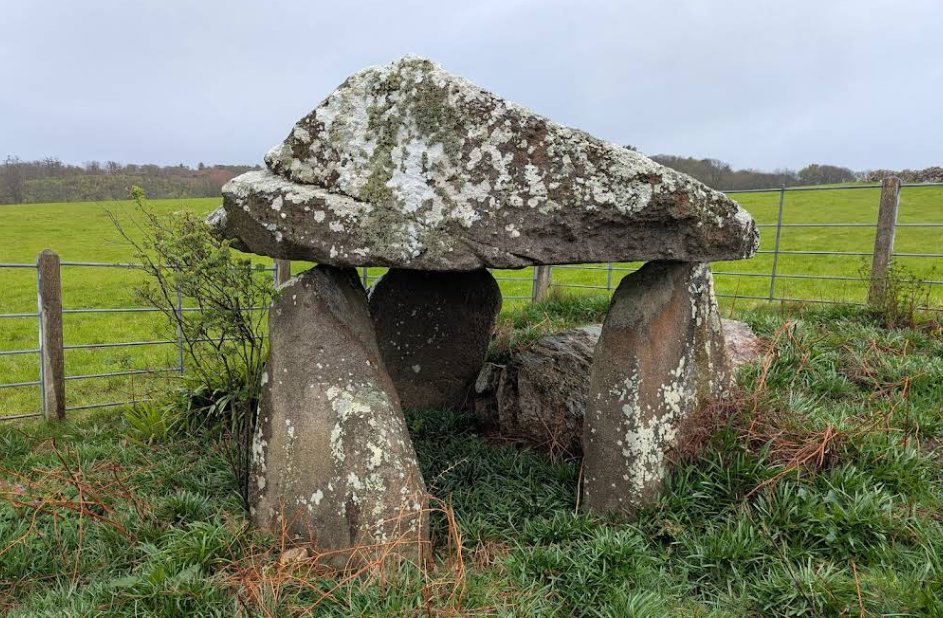
Dad had an OS map to guide us to a “cromlech” marked in Old English script to indicate it was from prehistory. It is now called Cefnamwlch on Google Maps – three vertical rocks with a flat one across the top, and a fence round it for protection. It was quite a hike to get there from the cottage (and back again) but funnily enough I’ve since found that Llangwnadl has its own, equally impressive ancient monument: a standing stone called Maen Hir, in a field just off the main road. I have no recollection of ever being taken to see that (but that doesn’t mean we weren’t).
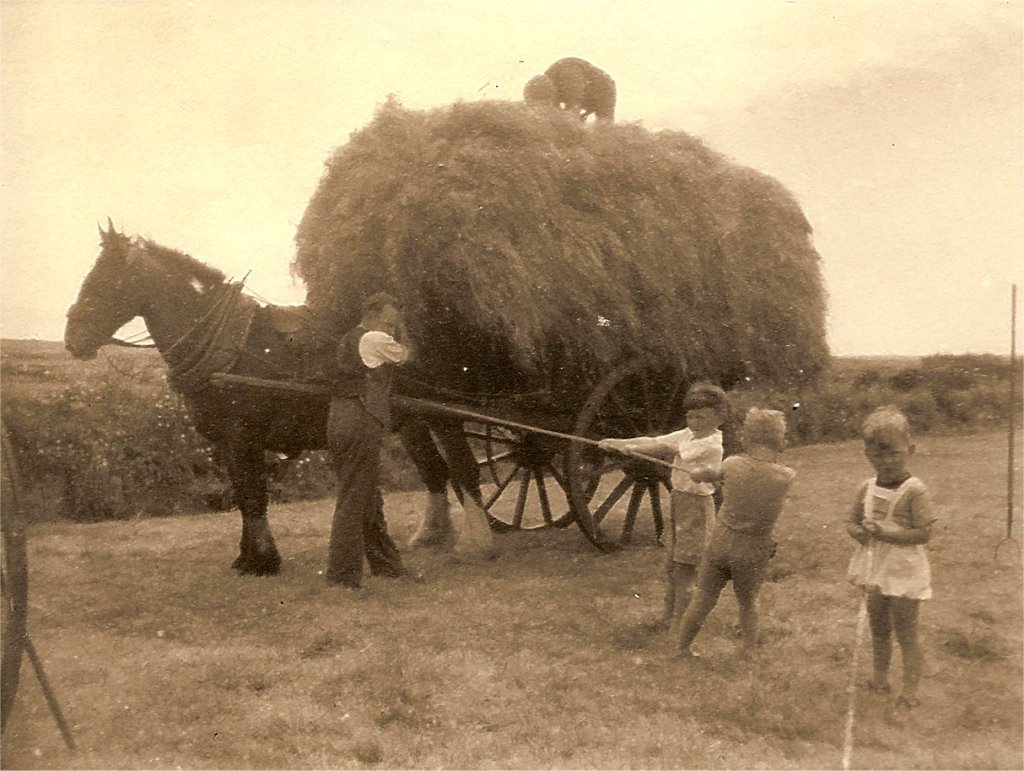
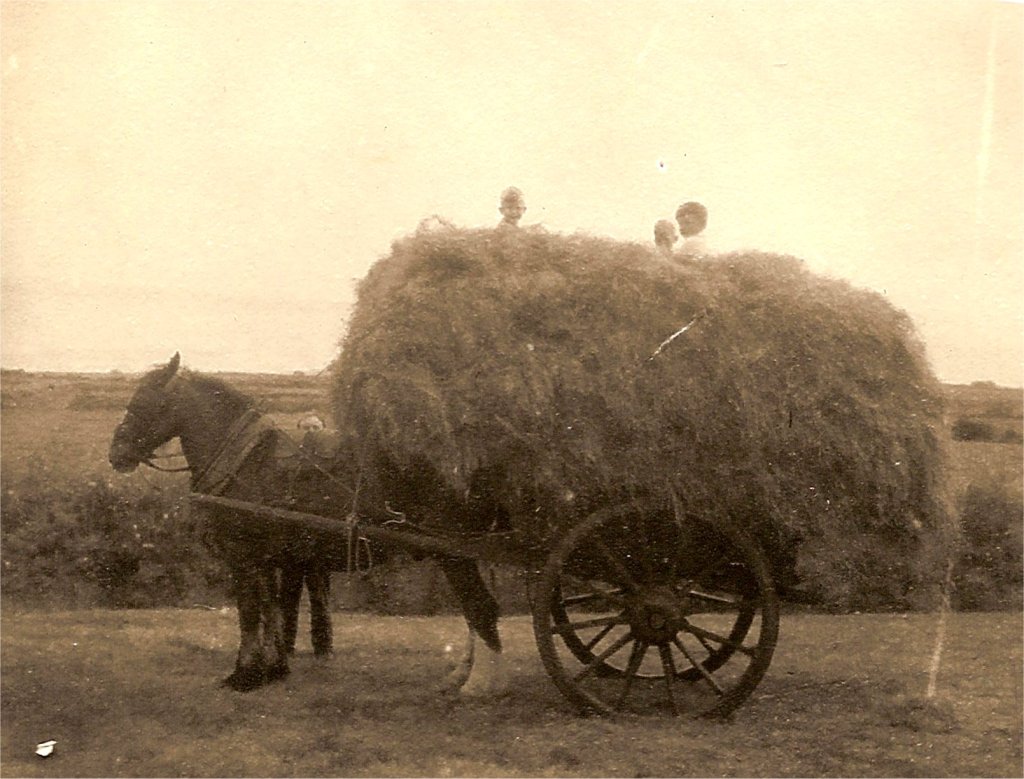
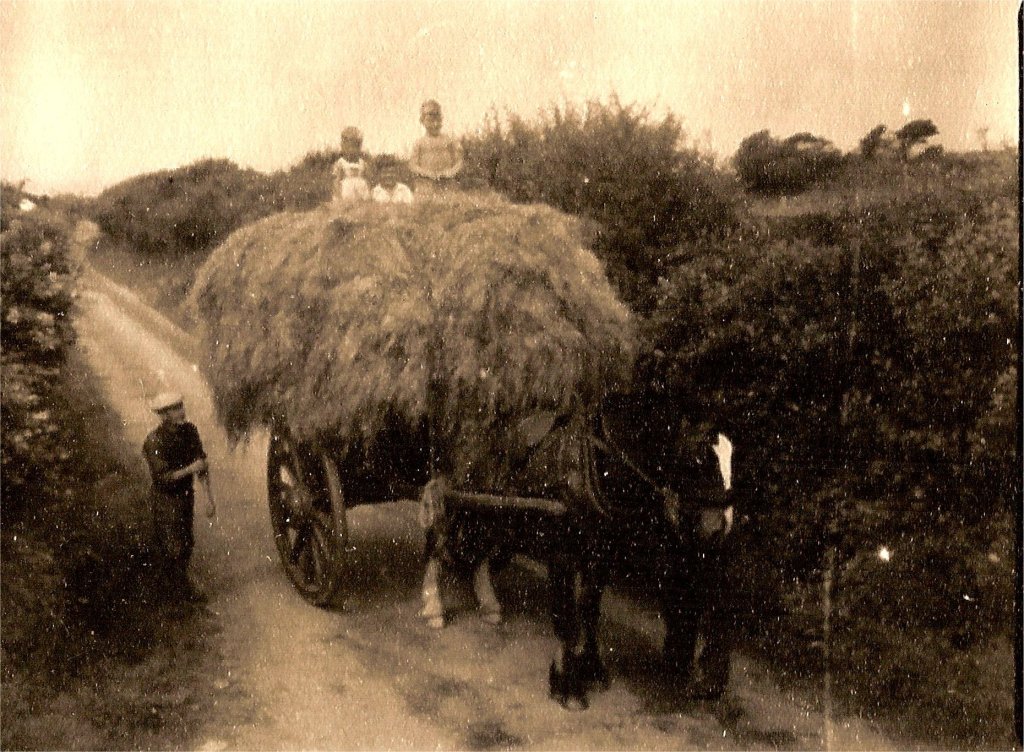
On the holiday in Efail Bach with Lynne and Roger from next door, when we were old enough to go and take part in the haymaking on one of the farms, or rather the loading of hay on horse-drawn wagons. Although Lynne was the oldest, either she didn’t want to come or it was deemed “unladylike” for a girl, only the three boys, me (8) Roger (7) and Ian (5) went along. We watched the wagon being loaded with pitchforks, then when it was impossibly high the load was tied down with ropes and we were somehow hoisted on top where we were instructed to hold onto a rope and not to let go. Such were health and safety regulations for children in 1950s Wales! Then followed a ride through the fields gateways and lanes back to the barn where we alighted. The grainy photographs taken by Dad are evidence that it happened, though I can remember snatches of it, certainly the bouncing ride clinging on to ropes. Better than any of today’s theme parks.
We did take bus trips to other places in the locality. Aberdaron was the nearest “proper” seaside village, with real shops, so we always liked going there. It was a (relatively) short walk to see Bardsey Island off the tip of the peninsula, one of the claimants to being King Arthur’s mythical Avalon, but we never made it across the choppy strait separating it from the mainland.
On the way to Aberdaron was Porth Oer, also known as “Whistling Sands” because swinging a bare foot rapidly across the sand on the beach would create a high pitched note. It’s not the only place you can do this but the first one we’d seen. I’ve since learned that this happens when all the grains of sand are the same size, which is not the case on most beaches. It’s now under the protection of the National Trust with a sizeable car park.
The longest bus journey we went on while at the cottage was to Pwllheli, to visit Auntie Nell. Nell was one of Mum’s numerous “Welsh Aunties” (in truth there were only two we ever visited, though it felt like more). I think Nana would have come along as well if she’d been at the cottage with us. Three of Mum’s grandparents had emigrated from north Wales to Liverpool in the 1870s, all from big families and Nell was actually Mum’s second cousin, though 20 years older (I’m not even sure if Mum knew their precise relationship). She was a little Welsh lady with a beaming smile, always pleased to see us, though of course we’d both been instructed to be on our best behaviour. She was 54 years old, which was old when you’re seven) and lived well into her eighties.
Nell lived in a little terraced cottage on New Street, facing the sea, probably half a mile walk from the town centre. Her little front room can’t have changed in decades. A coal fire, Victorian furniture and lots of ornaments; every time I visit a “living museum” I see a replica of it. I’d assumed Nell lived alone but I’ve since found her elder brother Robert and his wife probably lived nearby (well they did in 1939 and I have to keep reminding myself this was only fifteen years and a world war later). We never met them but of course Robert, at least, would have been at work.
As with most holidays I’ve no recollection of any return trip. I’m guessing we usually slept through it. I’ve only been back to the western end of the Lleyn peninsula once or twice since (it’s an awful long way from Faringdon with very little in the way of fast roads to get there) but it’s still a beautiful part of Britain, very much isolated even from the rest of Wales and I’m still grateful to Emlyn and Lu for giving us an opportunity to get to know it when we were so young.

 Dave's Memories
Leave a comment